
Thailand's 13th NESDP and Agriculture Direction: From Traditional to High-Value Farming
Deep-dive analysis of Thailand's 13th National Economic and Social Development Plan and current policies driving Thai agriculture toward Precision Agriculture, BCG Model, and farmer income enhancement through AgriTech
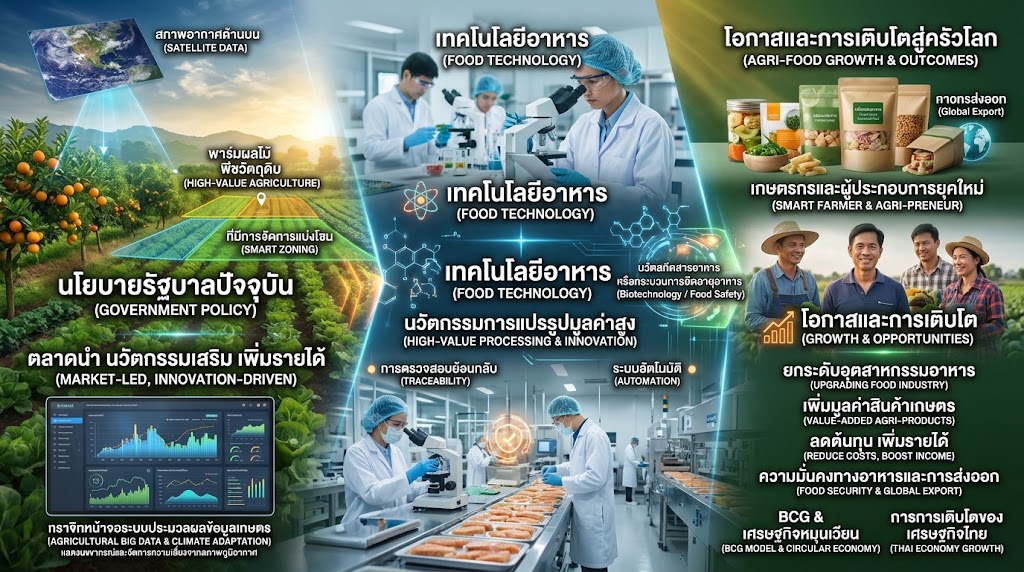
Thai agriculture is at its most critical turning point in decades. Under the 13th National Economic and Social Development Plan (2023–2027) and the Ignite Thailand: Agriculture Hub vision, the government has laid out a roadmap to transition from “traditional agriculture” to “high-value agriculture” with the primary goal of sustainably increasing farmer incomes.
“Market-driven, innovation-backed, income-focused” — The government’s core philosophy for transforming agriculture
This article by KoMoMi summarizes key policy directions, technology opportunities, and in-depth analysis for AgriTech developers and entrepreneurs.
📌 Part 1: Key Government Directions and Policies
The latest agricultural developments are driven by four main pillars:
1. Precision & High-Value Agriculture
The government promotes reducing monoculture crops that consume excessive water and yield low returns, shifting toward Future Crops and high-value alternatives.
| Shifting From | Moving To |
|---|---|
| Rice-only / Sugarcane | Coconut, Avocado, Hemp |
| High water / Chemical use | Drip irrigation, Organic fertilizer |
| Raw selling | Processing / High-value exports |
Technology needed: IoT systems measuring soil moisture and quality, plus data analytics platforms to help farmers choose the right crops for their fields.
2. Climate Change Adaptation
El Niño and La Niña phenomena are causing frequent Extreme Weather. The government focuses on:
- Proactive water management — Small reservoirs and solar-powered pumping systems
- Early warning systems — Predicting floods, droughts, and irregular rainfall
- Drought-resistant crops — Promoting varieties that withstand dry conditions
Technology needed: Real-time microclimate sensors and automated pump/valve control systems based on moisture readings.
3. BCG Model (Bio-Circular-Green)
The BCG policy emphasizes Zero Burn farming and adding value to agricultural waste.
| Waste/Byproduct | Value Added |
|---|---|
| Rice husk, Straw | Organic fertilizer, Biomass energy |
| Fruit peels | Ethanol, Essential oils |
| Animal manure | Biogas |
Technology needed: Carbon monitoring IoT for farms and carbon credit accounting platforms for farmers.
4. National Agricultural Big Data
Integrating data from multiple agencies to predict yields and prices, including satellite resource surveying.
Technology needed: AI/ML for satellite image analysis (Remote Sensing) and decision support systems for farmers.
💡 Part 2: AgriTech Opportunities — The Gap Between Policy and Field
Opportunity 1: Low-Cost IoT for Small-Scale Farmers
Problem: Ready-made Smart Farm systems are expensive and inaccessible to small-scale farmers.
KoMoMi’s proposed solution:
- ESP32 board + affordable sensors
- Zoning system controlling Solenoid Valves by zone
- Edge Computing — autonomous irrigation decisions without internet
- Mobile-friendly Dashboard, no coding required
Cost per zone: ~500-800 THB
Water savings: 20-40%
ROI: 6-12 months
Opportunity 2: Microclimate & Nowcasting
Problem: National-level weather data is too broad for agricultural needs.
KoMoMi’s development:
- Analyzing THEOS-2, Landsat satellite imagery
- Deep Learning models for Nowcasting extreme weather by location
- LINE alerts 6-12 hours before heavy rain
Opportunity 3: Smart Irrigation Analytics
Problem: Farmers don’t know how many liters/day to water, wasting water and electricity.
KoMoMi’s service:
- Analyzing sensor + weather + crop growth stage data
- Automatic ET₀ (Evapotranspiration) calculation
- Mobile alerts: “Water for X minutes today”
📊 Part 3: Challenges and Market Penetration Strategies
Main Challenge: The Technology Barrier for Farmers
Most Thai farmers are elderly and accustomed to traditional methods. Selling “technology” directly often fails because it’s seen as a cost rather than an investment.
Solution: Farming as a Service (FaaS)
Instead of farmers buying systems for tens of thousands, switch to Smart Farm Subscription:
| Old Model (Buy) | New Model (Rent/Subscribe) |
|---|---|
| Invest 30,000-50,000 THB | Pay 990-1,990 THB/month |
| Self-maintenance | Free installation + maintenance |
| No data analysis | Data Analyst team support |
| Risk of obsolescence | Free upgrades throughout contract |
Working with Government (B2G / B2B)
Going solo is slow. Key opportunities lie in partnering with government projects:
- Large-scale farming cooperatives — Shared water management across multiple farms
- Smart Farmer program — Department of Agricultural Extension initiatives
- BCG Model pilot farms — Low-carbon agriculture demonstrations
🎯 Conclusion: What Technology Will Win This Market?
Thai agriculture doesn’t need the most advanced technology — it needs technology that is:
| Attribute | Why It Matters |
|---|---|
| Stable | Works in all weather conditions, doesn’t fail often |
| Tangible | Farmers can see results with their own eyes |
| Affordable | Under 1,000 THB per zone |
| Real-time problem solving | Low water → instant alert |
| Works offline | Edge Computing for autonomous decisions |
The convergence of flexible IoT hardware + cost-effective self-hosted software + accurate AI will be the key driver in transforming Thai agriculture toward Ignite Thailand: Agriculture Hub.
KoMoMi is ready to partner as a consultant and full-stack Smart Farm system provider — from design and installation to data analytics to increase yields and reduce costs for Thai farmers.